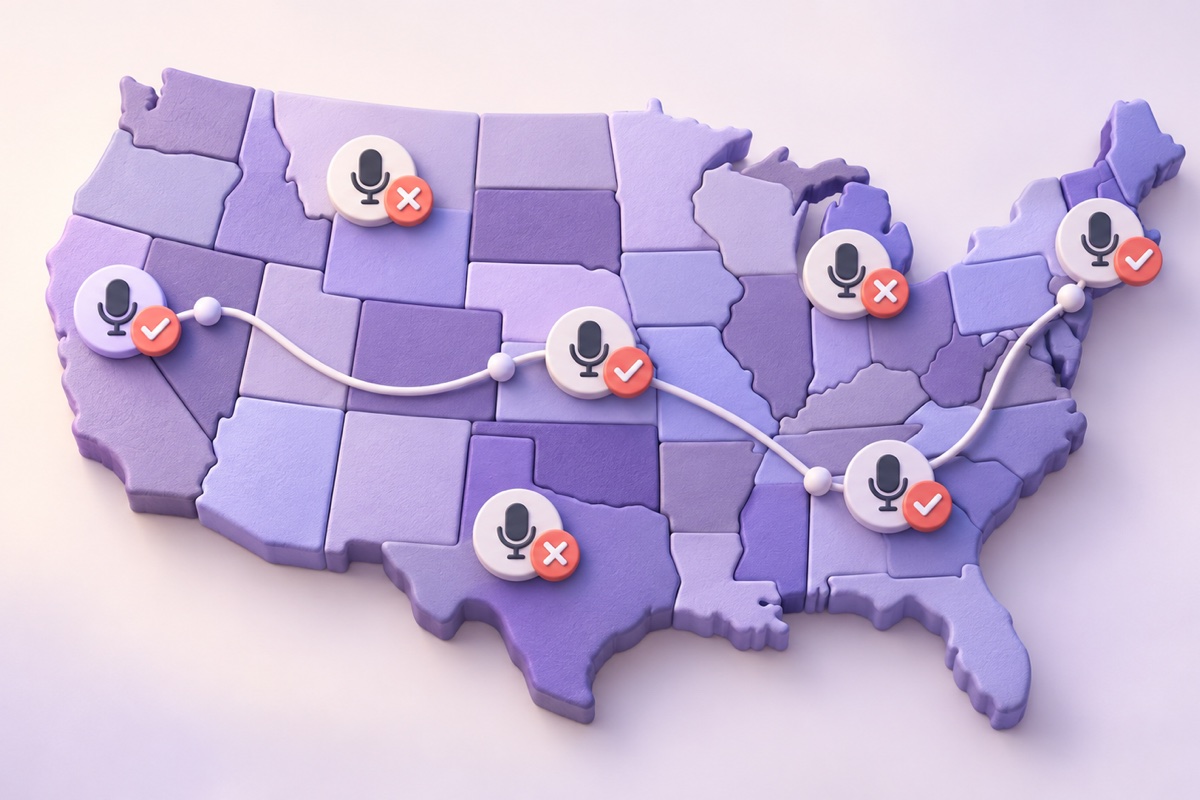
Recording Meetings in the US: A State-by-State Consent Guide
A practical 2026 guide to one-party, all-party, and mixed recording-consent laws across all 50 states and Washington, DC—including interstate meetings.
Can you record a meeting in the United States if you are part of it?
Under federal law, generally yes: the federal Wiretap Act has a one-party-consent exception. State law can impose a stricter rule, however, and modern meetings routinely include people in several states at once.
That is why a simple “one-party state” map is not enough. Some states distinguish in-person conversations from phone or electronic communications. Some protect only confidential or private conversations. Some treat a participant differently from an outside eavesdropper. Courts can also apply the stricter state’s law to an interstate call.
This guide gives a practical starting point for all 50 states and Washington, DC. It is not legal advice. Recording laws can carry criminal penalties and civil liability, and the answer depends on the facts. Verify the current statute and obtain advice for sensitive, covert, interstate, employment, healthcare, legal, or investigative recording.
The federal baseline
18 U.S.C. § 2511(2)(d) generally allows a person to intercept a communication when that person is a party to it or one party has given prior consent.
The exception does not apply when the interception is for a criminal or tortious purpose. Federal law also does not give a meeting participant permission to ignore a stricter state law.
In ordinary language:
- One-party consent means one participant can usually consent to the recording. If you are participating, that person can be you.
- All-party consent means every participant covered by the law must consent. “Two-party consent” is a common label but becomes inaccurate in a meeting with three or more people.
- No-party consent is not a lawful shortcut. An outsider generally cannot secretly intercept a private conversation merely because it occurs in a one-party state.
State-by-state meeting recording table
The classifications below use the Reporters Committee for Freedom of the Press recording guide as a secondary reference, with qualifications from the statutes linked below. They concern audio capture, not blanket permission for video or screen recording. “General one-party baseline” is shorthand, not an unconditional permission. Expectation of privacy, hidden-camera rules, purpose, location, and sector-specific law can still change the result. Updated September 24, 2026.
| Jurisdiction | Practical starting point | Important qualification |
|---|---|---|
| Alabama | One-party | A participant or a person with one participant’s consent may generally record. |
| Alaska | One-party | General rule; separate privacy or surveillance rules may apply. |
| Arizona | One-party | General rule for a participant or with one participant’s consent. |
| Arkansas | One-party | The recorder generally must be a party or have a party’s consent. |
| California | All-party for confidential communications | Consent is required from all parties when the conversation is reasonably expected to be confidential. Interstate calls involving California are high risk. |
| Colorado | One-party | General rule; unlawful-purpose and privacy claims remain possible. |
| Connecticut | Mixed | In-person conversations generally follow one-party consent. For private phone calls, §52-570d separately requires specified all-party consent, recorded verbal notice at the start, or a prescribed repeating warning tone, subject to exceptions. |
| Delaware | Treat as all-party | Overlapping statutes create uncertainty. The conservative approach is consent from everyone. |
| District of Columbia | One-party | A participant or someone with prior consent from one participant may generally record. |
| Florida | All-party for protected communications | All parties generally must consent when there is a reasonable expectation of privacy. |
| Georgia | One-party | A participant may generally record; rules differ for video in private places. |
| Hawaii | One-party with private-place restrictions | §711-1111 separately restricts surveillance in private places without consent from those entitled to privacy there. |
| Idaho | One-party | General participant-consent rule. |
| Illinois | All-party for private communications | All parties must consent where participants reasonably expect privacy; public and open-meeting exceptions matter. |
| Indiana | One-party | General rule for a party to the communication. |
| Iowa | One-party | State and federal provisions should both be considered. |
| Kansas | One-party | General rule; privacy claims can still apply. |
| Kentucky | One-party | General rule for a participant or with a participant’s consent. |
| Louisiana | One-party | General rule; recording for a criminal or tortious purpose is not protected. |
| Maine | One-party with private-place restrictions | Title 17-A §511 separately restricts surveillance in or into private places, including bathrooms and changing rooms, without the required privacy-holder consent. |
| Maryland | All-party | All parties generally must consent to recording protected private communications. |
| Massachusetts | All-party / anti-secret-recording | Secret audio recording is the central risk; open, known recording is treated differently. |
| Michigan | Mixed participant rule | RCFP classifies Michigan as all-party at least for an outside third party; state decisions have allowed a participant to record their own conversation. Use caution. |
| Minnesota | One-party | General rule for a participant or with one participant’s consent. |
| Mississippi | One-party | General participant-consent rule. |
| Missouri | Communication- and device-dependent | §542.402.2(3) provides one-party consent for wire communications. The oral-communication restriction in §542.402.1(2) specifically concerns radio-transmitting or transmission-interfering devices. RCFP’s all-party recommendation for private in-person conversations is a cautious approach, not an unqualified rule for every recorder. |
| Montana | All-party / notice-oriented | Recording a private conversation generally requires knowledge or notice to participants, subject to exceptions. Obtain everyone’s consent. |
| Nebraska | One-party | General rule; separate privacy claims may apply. |
| Nevada | Mixed | In-person conversations generally use one-party consent; telephone calls are treated as requiring all-party consent. |
| New Hampshire | All-party | All parties generally must consent to protected communications. |
| New Jersey | One-party | General participant-consent rule. |
| New Mexico | One-party | Federal-style baseline is the practical starting point; hidden-camera and privacy rules are separate. |
| New York | One-party | A participant may generally record without notifying the others. |
| North Carolina | One-party | A participant or a person with one participant’s consent may generally record. |
| North Dakota | One-party | General rule for a participant or with participant consent. |
| Ohio | One-party | General rule; do not rely on it for criminal or tortious conduct. |
| Oklahoma | One-party | General participant-consent rule. |
| Oregon | Mixed / notice-oriented | ORS 165.540(1)(c) generally requires all participants in an in-person conversation to be specifically informed of capture; that is not an affirmative-consent requirement. Phone calls generally use one-party consent. Exceptions are detailed. |
| Pennsylvania | All-party | All parties generally must consent to protected communications. |
| Rhode Island | One-party | General rule; an improper purpose can defeat the exception. |
| South Carolina | One-party | General participant-consent rule. |
| South Dakota | One-party | General rule for a party or with one party’s consent. |
| Tennessee | One-party | General participant-consent rule. |
| Texas | One-party | General rule; Texas biometric and privacy laws may create separate duties for voice processing. |
| Utah | One-party | General participant-consent rule. |
| Vermont | Federal baseline | Vermont has no broad state interception statute equivalent, so the federal one-party rule is the usual starting point. Other privacy law still applies. |
| Virginia | One-party | General participant-consent rule. |
| Washington | All-party for private communications | RCW 9.73.030 generally requires consent from all participants to a private conversation or communication. The statute describes ways consent may be announced and recorded. |
| West Virginia | One-party | General rule for a party or with one party’s consent. |
| Wisconsin | One-party | A participant may generally record, but use or admissibility can involve additional rules. |
| Wyoming | One-party | General participant-consent rule. |
The states that do not fit a red-or-green map
The RCFP introduction groups eleven states as primarily all-party jurisdictions: California, Delaware, Florida, Illinois, Maryland, Massachusetts, Michigan for at least third-party recording, Montana, New Hampshire, Pennsylvania, and Washington. That is a guide’s grouping, not eleven identical statutory consent requirements: notice, secrecy, confidentiality, and participant status matter.
Four further states need communication-specific treatment:
- Missouri: a one-party wire-communication exception, but a narrower, device-specific oral-communication provision that needs separate analysis;
- Oregon: all-participant notice generally required for in-person capture, one-party consent generally sufficient for telephone calls;
- Connecticut: one-party criminal baseline, plus a civil telephone rule with specified consent or notice alternatives;
- Nevada: stricter for phone calls, one-party for in-person conversations.
Hawaii and Maine add another fact-sensitive category: one-party is the general rule, but separate private-place surveillance statutes require consent from people entitled to privacy in the place. That is not necessarily the same group as the conversation’s participants.
Those distinctions explain why lists on the internet disagree. Some count only the primarily all-party states. Others add mixed states. Some treat Michigan as all-party without explaining its participant exception. Others label an entire state based on telephone law while ignoring in-person law.
The correct answer begins with the communication, not the colour on a map.
“Private” and “confidential” are factual questions
Many recording statutes protect conversations only when participants have a reasonable expectation of privacy or confidentiality.
Courts may consider:
- whether the conversation occurred in a home, office, public street, conference room, or open meeting;
- whether bystanders could hear it;
- whether the participants lowered their voices or closed a door;
- whether recording devices were visible;
- whether a platform gave notice;
- the sensitivity of the subject; and
- what the participants said about confidentiality.
A public location does not automatically make every conversation public. A private office does not automatically make every word confidential. The analysis is specific to context and state law.
For routine business meetings, relying on the absence of an expectation of privacy is usually worse than giving clear notice and obtaining agreement.
Interstate and remote meetings
A Zoom, Meet, Teams, or phone call can connect a host in New York, a customer in California, an employee in Pennsylvania, and a vendor in Texas.
Check the statute’s definitions of oral, wire, and electronic communications. A video meeting does not automatically inherit every rule or exception for a traditional telephone call.
Which state’s law controls can depend on where the recording occurred, where each participant was located, where the injury was felt, contractual choice-of-law terms, and the forum hearing the dispute. California’s Supreme Court, for example, has applied California’s stricter protection to calls with out-of-state businesses in circumstances involving California residents.
Our conservative operational recommendation for routine meetings is:
When participants may be in different states, obtain affirmative consent from everyone before recording.
If that is not workable for a recurring process, have counsel define the permitted workflow and configure the product to match it. Do not ask hosts to perform a conflict-of-laws analysis live on every call.
This is a conservative operating recommendation, not a claim that the strictest state’s law automatically governs every dispute. Consent also does not override separate employment, confidentiality, or data-protection restrictions.
Does a platform banner count as consent?
It can be evidence of notice or implied consent, but the answer is not universal.
The RCFP guide notes that consent is often implied when a recording device is in plain view or people are warned and continue speaking. Some statutes expressly describe how an announcement can establish consent. Other laws, contracts, or organisational policies may require something more explicit.
A robust meeting flow should:
- display notice before entry;
- state the notice aloud and obtain the required agreement before substantive capture;
- document affirmative agreement for the conservative cross-state workflow, without assuming permission to record that agreement before the applicable prerequisites are met;
- repeat notice for late joiners;
- provide a way to continue without recording; and
- preserve the consent log with the artifact.
Silence is weakest when declining would mean missing a required work meeting, medical appointment, interview, or essential service.
AI notes can still be a recording-law issue
Some products save video. Others save audio, a transcript, notes, or only a summary. Calling a feature “AI notes” does not decide whether interception or recording law applies.
The system may still acquire the contents of an oral or electronic communication. It may also create separate issues under biometric, employment, consumer-privacy, healthcare, education, or data-protection law.
Ask about each stage:
- Does the product capture system audio or microphone audio?
- Is raw audio buffered, transmitted, or retained?
- Is a verbatim transcript created?
- Are speaker embeddings or voiceprints generated?
- Does a human review any content?
- Who receives the summary?
- Is the content used for product improvement or model training?
Deleting the audio after transcription does not retroactively answer whether the initial capture was lawful.
Employer policies do not solve every meeting
An employee handbook may notify workers that business systems are monitored or meetings may be recorded. That can be relevant, but it is not universal consent from customers, job candidates, contractors, family members, patients, or employees located in jurisdictions with stricter requirements.
It may also be too general for a new purpose such as emotion inference, voiceprints, performance scoring, or model training.
Employers should pair policy notice with meeting-level controls and a documented purpose. High-risk conversations—discipline, termination, accommodations, investigations, legal advice, and health matters—deserve a separate decision rather than an automatic bot.
A practical recording checklist
Before capture:
- identify the participants’ likely locations;
- determine whether the meeting includes sensitive or privileged material;
- choose the minimum artifact needed;
- confirm recipient and sharing settings;
- give clear notice and obtain the required agreement; and
- provide a non-recorded alternative.
During capture:
- keep the recording indicator visible;
- notify late joiners;
- stop when the audience or purpose changes; and
- avoid side conversations that fall outside the disclosed purpose.
After capture:
- restrict access to intended recipients;
- correct material transcript errors without hiding the original record;
- apply a defined retention period;
- preserve relevant material when a legal hold applies; and
- delete redundant audio, transcripts, summaries, and exports when authorised.
What local processing changes
A local meeting-notes workflow can reduce the number of companies that receive a conversation and avoid an external bot joining the call. With Summit and Local Models selected, capture, transcription, speaker separation, summarisation, storage, and search can stay on the Mac.
It does not change the consent category of the state. Local recording is still recording. The user still needs to give required notice, obtain consent where applicable, protect the device, and set retention.
Summit’s optional hosted summarisation and iCloud features create additional paths when enabled. The precise boundary is described in the security architecture.
The practical takeaway
Federal law supplies a one-party starting point, not a nationwide permission slip. RCFP groups eleven states as primarily all-party, but participant exceptions, notice alternatives, device-specific provisions, and private-place rules make a simple count misleading. Interstate meetings add a separate choice-of-law question.
For routine organisational meetings, our conservative recommendation is to give notice, obtain everyone’s affirmative agreement, offer a non-recorded path, and stop capture when the meeting changes purpose. Have counsel address the applicable requirements and exceptions; agreement alone does not resolve every legal duty.
For individuals, “I was in the meeting” is not enough when another participant may be protected by a stricter state’s law.
Sources
- 18 U.S.C. § 2511: Interception and disclosure of communications
- Reporters Committee for Freedom of the Press: Introduction to the Reporter’s Recording Guide
- Reporters Committee for Freedom of the Press: State-by-state Recording Guide
- Washington State Legislature: RCW 9.73.030
Try Summit on macOS for bot-free meeting notes with a fully local processing path.