Can You Record an AI Meeting in Europe? Why GDPR Is Only Half the Answer
How GDPR, ePrivacy confidentiality, national recording laws, workplace monitoring, and AI processing interact when meetings are recorded in Europe.
“We have a GDPR lawful basis” is not a complete answer to whether an organisation may record a meeting in Europe.
The GDPR governs processing of personal data. It does not replace the confidentiality of communications, national criminal laws protecting the spoken word, employment rules, professional secrecy, contractual restrictions, or a meeting host’s policy.
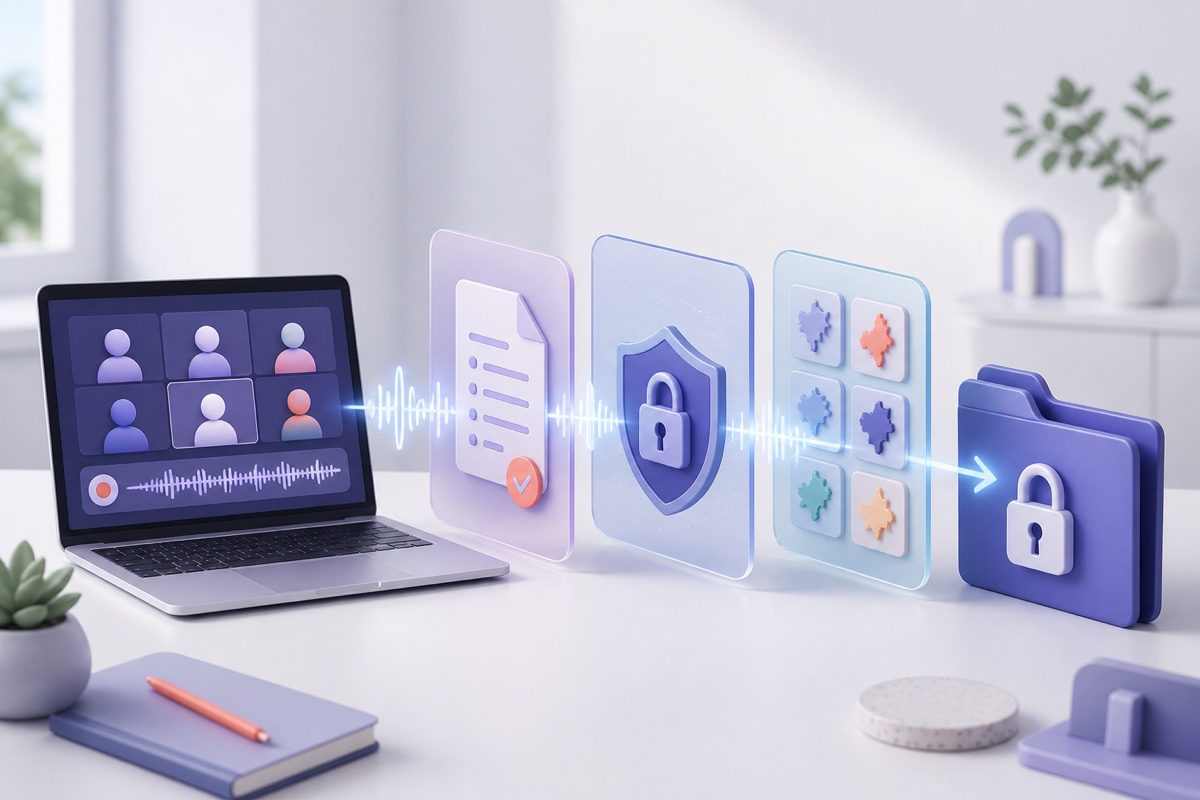
An AI notetaker makes the analysis more complex because it can turn one conversation into several records: audio, transcript, speaker labels, summary, tasks, prompts, search indexes, and exports. Different providers may process different stages.
The right starting point is not “Does GDPR require consent?” It is three separate questions:
- May we capture this conversation at all?
- May we process the resulting personal data for this purpose?
- May we use the output in this workplace, sector, or professional context?
All three need a defensible answer. This guide provides a framework, not legal advice.
GDPR regulates the data, not the whole act of recording
A meeting recording or identifiable transcript will usually contain personal data. Names, voices, opinions, attendance, timestamps, performance comments, and statements about other people can all identify individuals directly or indirectly.
The GDPR therefore requires the controller to address, among other things:
- the principles of lawfulness, fairness, transparency, purpose limitation, data minimisation, accuracy, storage limitation, and security under Article 5;
- an Article 6 lawful basis for each purpose;
- an Article 9 condition if special-category data is processed;
- clear information under Articles 13 or 14;
- processor contracts and subprocessor controls under Article 28;
- international-transfer rules where relevant;
- access, correction, objection, and erasure rights; and
- a data protection impact assessment under Article 35 where processing is likely to create high risk.
But the GDPR does not itself grant permission to intercept or record every conversation for which a lawful basis can be identified. Article 6 is one layer, not a recording licence.
The ePrivacy layer protects communications
Article 5 of the ePrivacy Directive requires Member States to ensure the confidentiality of communications and related traffic data through public communications networks and services. Listening, tapping, storage, or other interception or surveillance by people other than users is generally prohibited without user consent, except where legally authorised.
Article 5(2) preserves legally authorised recording in lawful business practice for the purpose of providing evidence of a commercial transaction or other business communication. Recital 23 adds useful safeguards: parties should be informed before recording about the recording, its purpose, and storage duration, and the recording should be erased as soon as possible within the applicable challenge period.
This is not a universal permission for “business meetings.” The exception must be implemented in national law, the recording must be legally authorised, and GDPR obligations still apply. A brainstorming session recorded for future AI search is not automatically equivalent to a regulated transaction recorded as evidence.
The Directive’s precise application can also depend on the service, the actor, and national implementation. That is why country-specific advice remains necessary.
Lawful basis does not always mean consent
GDPR consent is one possible Article 6 basis, not the only one. An organisation might consider legal obligation, performance of a contract, public task, or legitimate interests depending on the circumstances.
Each basis has limits:
- Consent must be freely given, specific, informed, and unambiguous, and it must be as easy to withdraw as to give. In employment, the power imbalance often makes freely given consent difficult.
- Legitimate interests requires a real purpose, necessity, and a balancing assessment against participants’ rights and reasonable expectations. It does not cancel separate recording laws.
- Legal obligation must be grounded in an applicable legal requirement, not merely an internal preference to keep records.
- Contract is narrow: the recording must be objectively necessary for the contract with the individual, not simply useful to the organisation.
The European Data Protection Board’s recording FAQ says clients whose calls are recorded for quality improvement must be informed about the purposes, recipients, right to object, and right of access. That is a useful minimum transparency signal, not a complete legal test for every meeting.
National law can change the answer
Europe does not have one recording-consent rule. National criminal, civil, employment, and telecommunications laws continue to matter.
Germany: the spoken word has separate criminal protection
Section 201 of the German Criminal Code criminalises, without authorisation, making an audio recording of another person’s privately spoken words and using or making such a recording available to a third party.
That issue is separate from choosing a GDPR lawful basis. In an ordinary non-public meeting, the practical default is to obtain agreement from everyone before audio capture begins.
France: private or confidential words receive specific protection
Article 226-1 of the French Penal Code addresses intentionally capturing, recording, or transmitting privately or confidentially spoken words without the speaker’s consent. It also says consent is presumed in specified circumstances when the acts are performed openly and knowingly and the person could object but did not.
That presumption is fact-dependent. A tiny app indicator, an unrecognised bot name, or a statement made after capture begins should not be treated as a universally valid consent mechanism.
United Kingdom: outside the EU, but still part of the operational picture
The UK is no longer governed by EU GDPR or EU ePrivacy law in the same way, but UK GDPR, the Data Protection Act 2018, communications rules, employment duties, and sector requirements still apply.
The ICO’s worker-monitoring guidance says monitoring must be lawful and fair, tied to a clear purpose, and carried out using the least intrusive means. Its call-monitoring guidance says workers and callers must be informed about recording and its purpose and warns that continuous audio monitoring is particularly intrusive.
For a meeting spanning several countries, applying only the organiser’s home-country rule may miss obligations where other participants are located.
Notice, consent, and platform indicators are different controls
A recording icon or visible bot can help people notice that something is happening. It usually does not explain:
- the controller’s identity;
- every purpose of processing;
- the lawful basis;
- whether audio is retained or immediately transcribed;
- which transcription and AI providers receive content;
- whether data leaves the EEA or UK;
- who may search or share the notes;
- whether the output will be used to evaluate workers; or
- retention periods and individual rights.
Conversely, a desktop tool that adds no bot may still be used transparently if the organiser gives clear notice and follows the applicable legal process before starting it.
“Bot-free” describes interface architecture. It does not mean notice-free.
Workplace meetings need a higher bar
The workplace changes both expectations and power.
An employee may not be able to refuse a mandatory meeting without consequences. Recordings can capture health conditions, union activity, political opinions, alleged misconduct, family circumstances, or legal advice. Searchable summaries can later be repurposed for performance management or discipline.
Before recording employee meetings, an organisation should document:
- the specific purpose;
- why less intrusive notes will not achieve it;
- the applicable lawful basis and any Article 9 condition;
- the separate authority to record under national law;
- how employees and external participants are informed;
- who can access, correct, export, and delete the result;
- whether the output can be used for employment decisions; and
- the retention period for each artifact.
A DPIA is especially appropriate where recording is systematic, involves vulnerable people or sensitive data, produces evaluations, or is combined with other monitoring.
Special-category and biometric data are separate questions
A voice recording can reveal health, ethnicity, religion, political opinions, trade-union membership, or other special-category information through what people say. That can trigger Article 9 even when the tool performs no biometric processing.
Voice becomes biometric data under the GDPR when it results from specific technical processing relating to a person’s characteristics and allows or confirms unique identification. Ordinary audio and speaker diarization are not automatically biometric identification.
Ask what the system actually does:
- Does it merely separate “Speaker 1” from “Speaker 2” within one meeting?
- Does it retain a voice representation across meetings?
- Does it match a speaker against an enrolled profile?
- Is the purpose unique identification, authentication, or something else?
Do not label every recording biometric. Do not assume a feature called “voice recognition” falls outside Article 9 either.
A Europe-ready recording workflow
1. Classify the meeting
Separate routine project meetings from HR, healthcare, legal, board, regulated-finance, works-council, and customer-support calls. Apply stricter defaults to sensitive categories.
2. Map participants and providers
Identify where participants are located, which organisation is controller, and every processor or subprocessor receiving audio, transcript text, or summaries.
3. Establish authority to record
Check national communications and spoken-word laws independently from the GDPR lawful basis. Record agreement where required.
4. Document the GDPR analysis
Define each purpose, lawful basis, sensitive-data condition, necessity assessment, retention rule, and international-transfer mechanism. Complete a DPIA when risk warrants it.
5. Give useful advance notice
Explain capture, purposes, recipients, processing location, retention, sharing, rights, and the alternative available to someone who objects. Give the notice before recording begins.
6. Minimise and separate records
Decide independently whether to retain audio, transcript, summary, speaker labels, prompts, and exports. Do not keep the most intrusive artifact merely because the product defaults to it.
7. Verify before consequential use
Allow correction of misattributed speech and inaccurate summaries. Require human review before notes influence employment, healthcare, legal, financial, or disciplinary decisions.
What local processing changes
With Summit and Local Models selected, meeting capture, transcription, speaker separation, summarisation, storage, and search can happen on the Mac. This can remove a cloud transcription vendor and hosted meeting repository from the default path, reduce international transfers, and make the explanation to participants more concrete.
It does not remove the need for authority to record, an Article 6 lawful basis, an Article 9 condition where required, transparency, retention limits, security, or employee safeguards.
Summit also supports optional hosted and self-hosted language-model providers. If a hosted provider is selected, relevant transcript excerpts are sent to that endpoint. Optional iCloud sync is another deliberate data flow. Local database and audio files rely on macOS sandboxing, file permissions, and FileVault when enabled rather than separate in-app encryption. These boundaries are documented in Summit’s data-flow and security architecture.
The defensible benefit of local processing is narrower and stronger than “GDPR compliant”: fewer automatic recipients, fewer cross-border transfers, and more direct control over the record.
The bottom line
To record an AI-assisted meeting in Europe, do not stop after selecting a GDPR lawful basis.
Check the legal authority to capture the conversation, the data-protection rules governing every resulting artifact, and the employment or sector rules governing how the output will be used. Inform people before capture, minimise the data path, and avoid turning a convenience feature into permanent workplace surveillance.
Primary sources
- Regulation (EU) 2016/679 — General Data Protection Regulation
- Directive 2002/58/EC — ePrivacy Directive
- European Data Protection Board: Frequently Asked Questions
- German Criminal Code, Section 201
- French Penal Code, Article 226-1
- UK ICO: Monitoring workers
This article provides general privacy and workplace information, not legal advice. European recording rules vary by country and context. Obtain jurisdiction-specific advice for sensitive, covert, regulated, or multi-country recording.
Try Summit on macOS for bot-free meeting notes with a fully local processing path.