Are Voice Recordings Biometric Data Under GDPR?
GDPR Article 9 puts biometric data in a special category requiring explicit consent. If your cloud meeting tool processes voice for speaker identification, you may already be handling biometric data — and you might not have the right consent.
Short answer: it depends on how the voice data is processed. Long answer: if your AI meeting tool is doing speaker identification, the answer is almost certainly yes — and GDPR’s rules for biometric data are significantly stricter than for ordinary personal data.
Here’s what that actually means for your organization.
What GDPR Says About Biometric Data
GDPR Article 9 creates a special category of “sensitive personal data” that gets heightened protection. Biometric data is on that list — specifically defined as:
“personal data resulting from specific technical processing relating to the physical, physiological or behavioural characteristics of a natural person, which allow or confirm the unique identification of that natural person, such as facial images or dactyloscopic data”
The critical phrase is “allow or confirm the unique identification.” A raw audio recording of a meeting isn’t automatically biometric data under GDPR. But the moment you process that audio to identify who is speaking — extracting voice embeddings, creating speaker profiles, running diarization — you’ve crossed into Article 9 territory.
And Article 9 processing requires explicit consent. Not “legitimate interests.” Not “contractual necessity.” Explicit. Opt-in. Documented.
The Speaker Identification Problem
Most modern AI meeting tools include speaker diarization — the feature that labels your transcript with “Speaker 1,” “Speaker 2,” or better yet, actual names. It’s useful. It also creates voiceprints.
Speaker diarization works by creating mathematical representations of vocal characteristics unique to each person. These embeddings are functionally equivalent to fingerprints — they can identify an individual across recordings, even without a name attached.
When those embeddings live in the cloud — on Otter.ai’s servers, Fireflies’ infrastructure, Zoom’s AI processing pipeline — you have biometric data stored by a third party. Under GDPR, your organization is the data controller. You’re responsible for the legal basis under which that processing happens.
“We didn’t know it was creating voiceprints” is not a GDPR defense.
What This Means in Practice
If your European employees (or EU-based meeting participants) are being recorded by a cloud AI meeting tool that does speaker identification, you need:
A valid legal basis. Explicit consent under Article 9(2)(a) is the cleanest option. This means asking every meeting participant — not just your employees, but external parties, clients, partners — for specific consent to biometric processing before the call starts.
A Data Protection Impact Assessment (DPIA). Article 35 requires a DPIA for large-scale processing of special category data. If you’re recording all company meetings, you likely qualify.
A processing agreement with your vendor. Under Article 28, your cloud meeting tool is a data processor. You need a Data Processing Agreement that specifies what they do with the biometric data, how long they keep it, and what happens if they have a breach.
Cross-border transfer compliance. If your meeting tool is US-based (most of them are), you need Standard Contractual Clauses or another legal mechanism for transferring biometric data outside the EU.
That’s a lot of paperwork for “who said what in the Tuesday standup.”
The Consent Problem Gets Worse
Here’s where it gets uncomfortable: consent must be freely given, specific, and informed. In an employment context, GDPR regulators in multiple EU countries have ruled that employee consent is often not freely given — because there’s an inherent power imbalance between employer and employee.
So “we told everyone in the employee handbook that meetings are recorded” may not satisfy GDPR’s consent standard for biometric data. You might need a different legal basis entirely — and for Article 9 biometric data, the options are narrow.
Penalties Worth Noting
GDPR fines for Article 9 violations aren’t theoretical. Special category data breaches typically trigger the higher tier: up to €20 million or 4% of global annual turnover, whichever is greater.
More practically: EU data protection authorities have been paying close attention to AI tools since 2023. Italy’s Garante has blocked AI services for GDPR violations. Ireland’s DPC has levied billion-euro fines. “We were using a US SaaS tool and didn’t think about it” has not historically been treated as a mitigating factor.
The Simpler Path
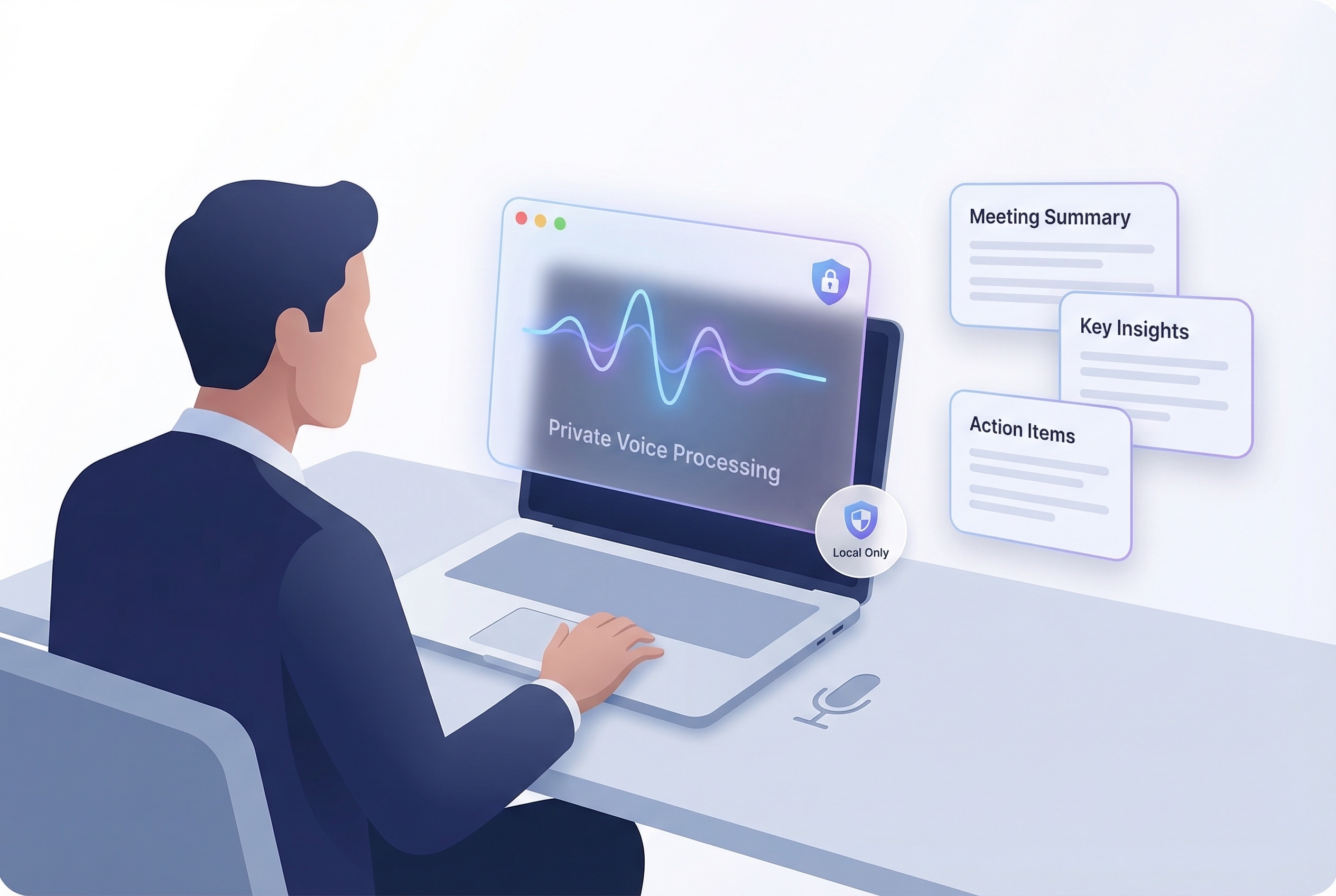
Summit processes audio on your device. No cloud. No server. No third-party processor.
When everything stays local, the GDPR analysis changes dramatically. You’re not transferring biometric data to a third party. You don’t need vendor processing agreements. Cross-border transfer rules don’t apply. The Article 9 consent requirements still exist if you’re processing for speaker identification — but the scope is one person (you), one device (yours), zero data controllers except yourself.
For organizations that want to skip the DPIAs and SCCs entirely: Summit also lets you disable speaker identification completely, so no voice embeddings are created at all.
Zero biometric data. Zero Article 9 exposure. Simple.
Try Summit — meeting notes that stay on your device. Download for macOS
References
- GDPR Article 9 — Processing of special categories of personal data
- GDPR Recital 51 — Definition of biometric data
- GDPR Article 35 — Data Protection Impact Assessment requirements
- EDPB Guidelines 3/2019 on processing of personal data through video devices
- Article 29 Working Party Opinion 2/2017 on data processing at work