BIPA and Voice Recordings: What Employers Need to Know
Illinois employers using AI meeting tools may be violating BIPA without realizing it. Employee voices are biometric identifiers under Illinois law. Written consent is required before collection — and the class action exposure is significant.
If your Illinois-based company uses an AI meeting notetaker — Otter.ai, Fireflies, Zoom AI Companion, Microsoft Copilot, take your pick — and it identifies who’s speaking, you may be collecting biometric data from your employees without their written consent.
Under BIPA, that’s not a compliance gap. It’s a lawsuit.
BIPA in 60 Seconds
The Illinois Biometric Information Privacy Act (740 ILCS 14) was passed in 2008 and hasn’t been defanged despite years of industry lobbying. The key requirements:
Section 15(a): Organizations must have a written policy establishing a retention schedule and guidelines for destroying biometric data.
Section 15(b): Before collecting biometric data, organizations must:
- Inform the individual in writing that biometric data is being collected
- Inform them of the specific purpose and length of time it will be used
- Obtain a written release (consent)
Section 15(c) and (d): You cannot sell or profit from biometric data, and must use “reasonable standard of care” to protect it.
Section 15(e): You cannot disclose it to third parties without consent (with limited exceptions).
The enforcement mechanism that makes BIPA actually scary: private right of action. Any affected person can sue without showing actual harm. Statutory damages are $1,000 per negligent violation and $5,000 per intentional or reckless violation — per person, per incident.
Voiceprints Are Biometric Identifiers
BIPA defines “biometric identifiers” to include voiceprints. Not “recordings.” Not “audio files.” Voiceprints — the mathematical model of someone’s unique vocal characteristics that enables identification.
The distinction matters. Recording a meeting isn’t automatically a BIPA issue. But when an AI tool analyzes that recording to determine who is speaking — extracting embeddings, building speaker profiles, running diarization — it creates voiceprints.
That’s when BIPA applies.
Most AI meeting tools with speaker identification create these voiceprints. It’s how “Speaker 1: Can we move the deadline?” becomes “John: Can we move the deadline?” in your transcript. The feature works by extracting a unique vocal signature and matching it against a stored profile.
If that processing happens on a cloud server and the voiceprints are stored there, BIPA’s requirements apply — even if your employees “agreed” to general recording policies in their employment contracts.
The Consent Timing Problem
Here’s where many employers run into trouble: consent must come before collection. Not in the employee handbook signed at onboarding. Not in a terms of service buried in a tool’s settings. Before biometric data is collected from that specific person.
Common mistakes:
- Deploying a meeting AI tool company-wide and notifying employees afterward
- Getting consent from direct employees but not from contractors or external participants
- Assuming “recording consent” in meeting invites covers biometric processing
- Relying on the meeting tool’s own consent mechanisms (which typically don’t satisfy BIPA’s employer-side obligations)
External meeting participants — clients, vendors, interviewees — are often completely uncovered. They never agreed to anything with your company. They showed up to a Zoom call. If your AI bot created a voiceprint of them, that’s a violation.
The Class Action Math
BIPA class actions have resulted in some of the largest privacy settlements in US history:
- Facebook: $650 million (facial recognition)
- Google: $100 million (facial recognition in Photos)
- TikTok: $92 million
- Various BIPA cases are working through courts right now targeting AI meeting tools specifically
Fireflies.AI faced a class action in December 2025 specifically over voiceprint collection without consent. Microsoft Teams, Zoom, and others have faced or are facing similar claims.
The math is brutal. Say your company has 200 employees in Illinois and you’ve been using a speaker-identifying AI tool for two years without proper consent. At $1,000 per negligent violation, with weekly meetings averaging 10 employee voice contacts each: the number compounds quickly. BIPA class action exposure can hit eight figures for mid-sized employers.
What Employers Should Do
Audit your tools. Which meeting tools does your organization use? Does any of them offer speaker identification or diarization? If yes, it’s likely creating voiceprints.
Check your consent records. Do you have written, specific consent for biometric collection from all affected employees? From external participants?
Review vendor contracts. Your AI meeting tool is processing biometric data on your behalf. Do you have contracts that address BIPA obligations? What are their retention and deletion policies?
Consult Illinois employment counsel. BIPA compliance for employers has nuances that warrant legal review, especially given evolving case law.
The Zero-Voiceprint Option
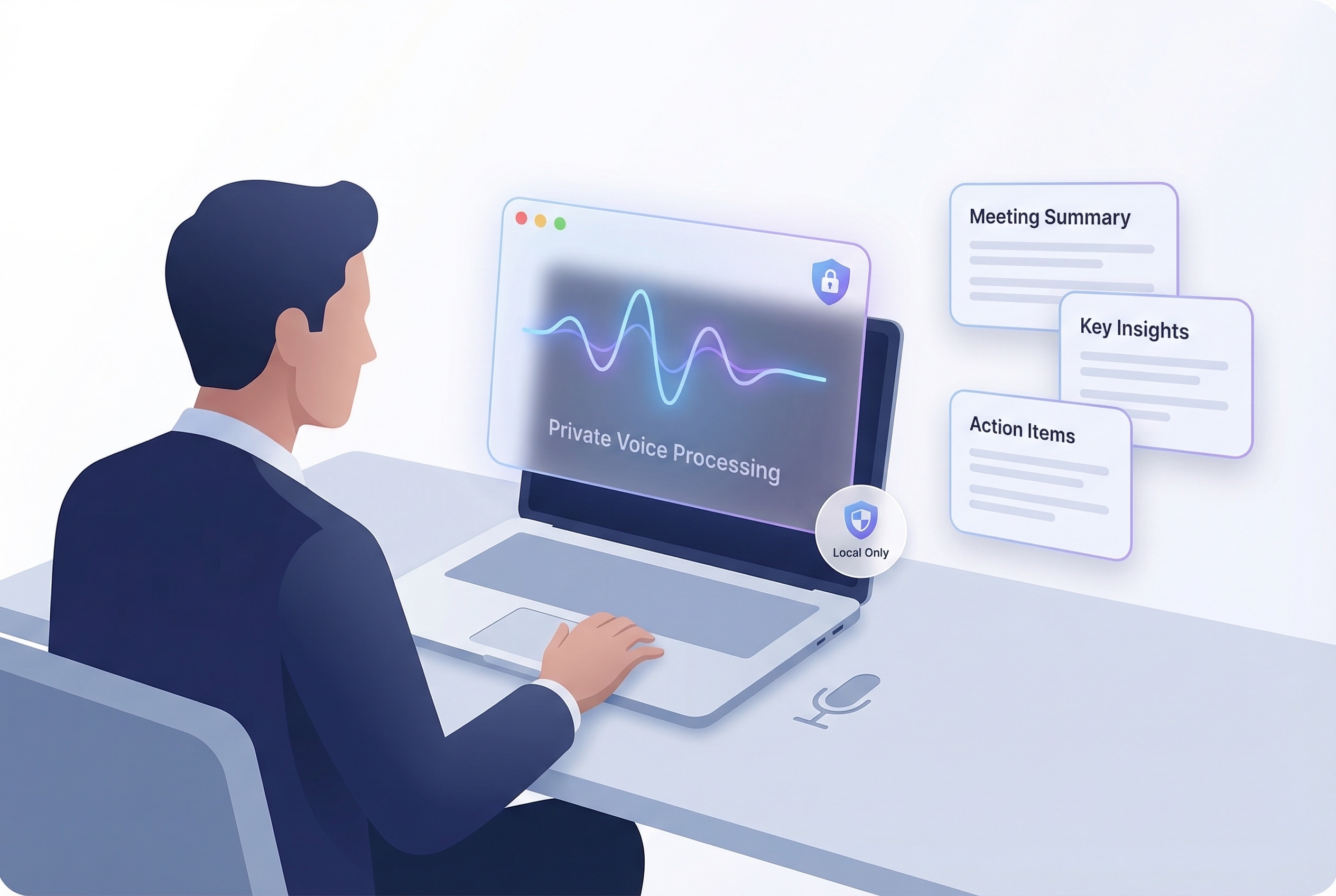
Summit doesn’t collect voiceprints. Processing is local to your Mac — no audio, no embeddings, no speaker profiles are sent to any cloud server. Speaker identification, when enabled, stores voice embeddings only on your device. You control retention. You delete them when you want.
For employers who want to eliminate the BIPA question entirely: disable speaker identification in Summit settings. No voiceprints created at all. You get transcripts, summaries, and action items — without any biometric data in the picture.
It’s not that compliance is complicated. It’s that most tools weren’t designed with compliance in mind.
Try Summit — meeting notes that stay on your device. Download for macOS
References
- Illinois Biometric Information Privacy Act, 740 ILCS 14/1 et seq.
- Cothron v. White Castle System, Inc. — Illinois Supreme Court (2023)
- Fireflies.AI BIPA class action complaint (December 2025)
- Facebook (Meta) BIPA settlement: $650 million (2021)
- Lyon Firm: BIPA litigation tracker (2026)