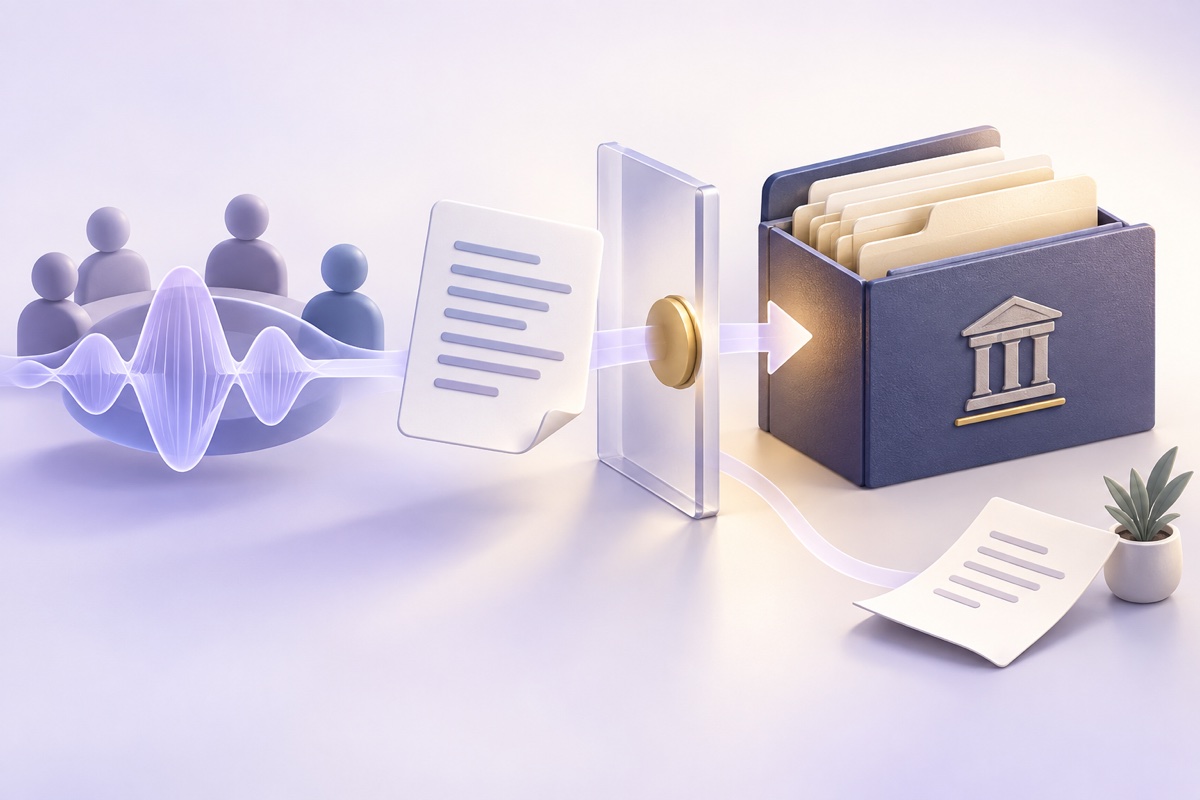
Are AI-Generated Meeting Notes Federal Records? NARA Now Answers Directly
NARA's 2026 guidance explains when AI transcripts, summaries, prompts, and audit trails become federal records—and when they likely do not.
An employee asks an AI assistant to summarise a meeting. Is the result a federal record?
The National Archives and Records Administration now gives a direct answer: sometimes.
In guidance issued on August 21, 2026, NARA specifically lists an AI-generated meeting transcript or summary as a common federal-agency use of AI. It says using an AI platform does not, by itself, create a federal record. What matters is how the input or output is created, maintained, and used.
An AI meeting summary is likely a federal record when it is circulated to colleagues or serves as the official meeting record. Notes kept only for one employee’s recollection, never circulated and never used as the official record, are likely not.
That distinction sounds simple. Turning it into a reliable system is not.
This article addresses US federal records management, not state or local public-records law, and is general information rather than legal advice.
NARA’s answer is based on use, not the AI label
The Federal Records Act definition is technology-neutral. Under 44 U.S.C. § 3301, recorded information is a federal record when it is made or received by a federal agency in connection with public business and preserved—or appropriate for preservation—because of its evidential or informational value.
NARA’s 2026 memo applies that definition to AI materials, including:
- prompts and queries;
- uploaded source material;
- model outputs;
- meeting transcripts and summaries;
- audit trails and usage logs;
- software, algorithms, and documentation; and
- records used to train a system.
The fact that an artifact was produced by AI is secondary. NARA directs agencies to look at the circumstances around it. Relevant factors include whether the agency:
- used it in official business;
- relied on it in decision-making;
- circulated it to others;
- integrated it into an agency system;
- controlled it; or
- must retain it for business or legal obligations.
This prevents two bad shortcuts. Agencies cannot declare every AI output a record merely because it exists. They also cannot call every AI output a disposable draft merely because a model produced it.
The clearest meeting-note examples
NARA identifies both sides of the line.
Likely a federal record
The memo says AI-generated meeting summaries are likely federal records when they are circulated to other employees or serve as the official meeting record.
That can include a summary that is:
- emailed to participants as the agreed account of decisions;
- saved in a project, case, grants, procurement, or policy file;
- used to assign and track official commitments;
- relied on to approve an action;
- incorporated into a briefing or decision memorandum; or
- maintained as documentation of an important board, committee, or staff meeting.
The record status comes from its role in agency business, not from whether the meeting tool calls it “AI notes,” “recap,” or “summary.”
Likely not a federal record
NARA says meeting notes created for a user’s recollection are likely not federal records when they are not circulated and are not used as the official meeting record.
This category resembles a personal convenience file: rough notes kept only to refresh the employee’s memory and not relied upon in agency decisions.
“Likely” matters. A note can change status through later use. A private recap that is forwarded to a team, placed in a case file, or used to justify a decision may cross the line. Agencies, not individual product vendors, have principal responsibility for making the determination based on their business needs and practices.
Classify each artifact separately
An AI meeting workflow does not create one thing. It may create six:
- raw audio;
- a verbatim or near-verbatim transcript;
- speaker labels and timestamps;
- an AI summary;
- prompts, corrections, and generated action items; and
- audit, access, and sharing logs.
These artifacts can have different purposes and different schedules. A reviewed summary may become the official record while the raw transcript is only an intermediary used to produce it. An audit log that is normally operational data may become a federal record when captured and used in an investigation. A prompt may be a record when it is saved in a case file to document how an agency performed a legally significant search.
Do not attach a single “record/non-record” label to the product account. Build a disposition map for each artifact and each use.
| Artifact | Question to ask |
|---|---|
| Audio | Is it evidence of the proceeding, or only an input used to create another record? |
| Transcript | Is it circulated, corrected, relied upon, or designated as the official account? |
| Summary | Does it document decisions, commitments, policy, or official action? |
| Prompts and edits | Are they needed to understand, reproduce, or defend the resulting work? |
| Action items | Are they used to conduct and track agency business? |
| Audit logs | Are they captured and used for security, investigation, or oversight? |
The answer should be recorded in the agency’s file plan or AI-use procedure—not reconstructed after a FOIA request, investigation, or litigation hold arrives.
“Temporary” still requires disposition authority
If an AI artifact meets the definition of a federal record, it cannot be deleted merely because the team considers it temporary.
NARA says every AI-related federal record requires a NARA-approved disposition authority: either a General Records Schedule or an agency-specific schedule.
Some AI records may qualify under General Records Schedule 5.2:
- A transitory record under item 010 is needed for less than 180 days and is not needed to satisfy a financial or legal obligation. It may be destroyed when no longer needed.
- An intermediary record under item 020 is used to create a subsequent record. It may be destroyed after that subsequent record is created, subject to the schedule’s conditions.
Other outputs follow the schedule applicable to the kind of work product. NARA gives the examples of an AI-generated email following the email schedule and an AI-generated final report following the report’s schedule. The tool does not supply the retention period.
A legal hold, investigation, audit, FOIA processing need, or other obligation may also prevent ordinary deletion. Records staff and counsel should define the exceptions before enabling automatic cleanup.
Cloud retention is not the federal-records test
NARA draws an important distinction around third-party AI platforms. Information passively retained by a provider is not necessarily “received” by an agency. The analysis changes if an employee downloads or captures it in an agency system and uses it for official purposes.
That means vendor storage and federal-record status are related operationally but not identical legally.
- A cloud service can retain material that is not a federal record.
- A local file can be a federal record.
- A provider’s 30-day deletion setting does not authorise destruction of an agency record.
- Keeping everything forever “just in case” is not a substitute for classification and scheduling.
Architecture determines who holds copies and how the agency can govern them. Use determines whether the artifact meets the records definition.
A workable agency policy for AI meeting notes
The hardest part is making employee behaviour match the recordkeeping decision. A useful policy should answer the following questions.
1. Which meetings may use AI capture?
Separate routine internal collaboration from adjudicative proceedings, investigations, procurement, grants, personnel actions, classified or controlled information, law enforcement, and meetings subject to specialised statutes or schedules.
“Approved AI tool” should not mean “approved for every meeting.”
2. What becomes the authoritative record?
Define whether the official artifact is approved minutes, a reviewed summary, a transcript, an audiovisual recording, or another record. Avoid leaving multiple apparently authoritative versions in different systems.
3. Who reviews accuracy?
AI can omit disagreement, invent consensus, confuse speakers, or alter numbers and dates. Assign a human owner to review substantive decisions and commitments before the output is circulated or filed.
Preserve necessary corrections and provenance under the applicable schedule.
4. Where is the record captured?
If a summary becomes a record, move or save it in the agency’s designated recordkeeping system with appropriate metadata. Do not rely on a meeting vendor’s workspace as an accidental archive unless the agency has explicitly governed it as one.
5. What happens to intermediary artifacts?
Identify the authority and trigger for disposing of audio, transcripts, drafts, and prompts after the official record is created. Include legal-hold and investigation overrides.
6. How will offboarding and account closure work?
Records must not disappear when an employee leaves, a licence expires, or an agency changes providers. Test export, transfer, access, and deletion before deployment.
What local AI changes for a federal agency
With Summit and Local Models selected, meeting capture, transcription, speaker separation, summarisation, storage, and search can run on the Mac. This can reduce disclosure to transcription and model vendors, avoid an external meeting bot, and give an agency more direct control over where working files exist.
It does not change the Federal Records Act test. If a local summary is circulated, used for official business, relied on in a decision, or designated as the meeting record, it may be a federal record. If the record exists only on one laptop, the agency still needs to capture and manage it in an approved system.
Local files also need endpoint security, access controls, FileVault, backup governance, and offboarding procedures. Summit’s optional hosted-model and iCloud features create additional data flows when enabled; agencies should assess the actual configuration described in the security architecture.
Local-first architecture can make custody simpler. It cannot turn a federal record into a personal file or provide disposal authority.
What the memo does not decide
NARA expressly limits the guidance to Federal Records Act requirements. It does not establish policy for AI governance, e-discovery, privacy, security, or ethical use.
It also should not be read as a complete answer to public disclosure. Whether material is a federal record, whether it must be searched for in response to a request, and whether a disclosure exemption applies are related but distinct legal questions.
Agencies still need their privacy, security, procurement, accessibility, civil-rights, FOIA, discovery, and substantive program analyses.
The practical answer
Are AI-generated meeting notes federal records?
If they are circulated, used to conduct official business, relied upon in decision-making, integrated into agency systems, or treated as the official meeting record, they are likely records. If they remain uncirculated notes used only for one employee’s recollection, they are likely not.
The durable control is not a checkbox in the meeting app. It is an agency policy that classifies every artifact, identifies the authoritative record, captures it in the right system, and disposes of temporary material only under an approved schedule.
Primary sources
- NARA AC 11.2026: Guidance on Applying the Federal Records Act to Artificial Intelligence Materials
- NARA: Full AI Materials Guidance (PDF)
- 44 U.S.C. § 3301: Definition of Federal Records
- NARA Bulletin 2023-04: Managing Records Created on Collaboration Platforms
Try Summit on macOS to evaluate bot-free, local AI meeting notes within your agency’s approved records workflow.