Your Voice Is Biometric Data. Why That Matters for AI Meeting Notes.
When a meeting bot records you, it's not just capturing words — it's collecting your voiceprint. Under laws like BIPA, that's the same category as fingerprints. And storing it in the cloud? That's a lawsuit waiting to happen.
When a meeting bot records you, it’s not just capturing words — it’s collecting your voiceprint. Under laws like Illinois BIPA, that’s biometric data. The same category as fingerprints and iris scans. And storing it in the cloud? That’s where things get legally complicated.
The Fireflies.AI Wake-Up Call
In December 2025, Fireflies.AI got hit with a class action lawsuit. The claim? Their “Speaker Recognition” feature creates voiceprints — unique vocal signatures that identify individuals — without obtaining written consent.
From the complaint:
“Fireflies.AI’s meeting assistant records, analyzes, transcribes, and stores the unique vocal characteristics (i.e., ‘voiceprints’) of every meeting participant… including people who never created a Fireflies account, never agreed to its terms of service, and never gave written consent.”
This isn’t a technicality. Under BIPA, collecting biometric data without prior written notice AND written consent is illegal. And Illinois allows private lawsuits — meaning any affected person can sue.
As of February 2026, Fireflies.AI is now listed in active BIPA litigation alongside Microsoft Teams, Apple Siri, and other Fortune 500 companies. The legal risk is real and expanding.
Why Voice Is Different From Other Data
When your password leaks, you change it. When your credit card is compromised, you get a new one.
But your voiceprint? That’s permanent. You can’t change how you sound.
This is exactly why biometric privacy laws exist. BIPA defines “biometric identifiers” as:
- Retina or iris scans
- Fingerprints
- Voiceprints
- Hand or face geometry
Speaker diarization — the feature that tells you “who said what” — typically works by creating voice embeddings. Mathematical representations of your unique vocal characteristics. Stored in a database. On someone else’s servers.
The Cloud Problem
Most AI meeting tools work like this:
Your call → Bot joins → Audio sent to cloud →
→ Voiceprint extracted → Stored indefinitely
Every link in that chain is a liability:
- Collection: Did you get written consent from ALL participants?
- Storage: Where does that biometric data live? For how long?
- Breach risk: If servers are compromised, voiceprints leak forever
And here’s the catch: many tools create voiceprints automatically as part of “speaker identification” — even if you didn’t explicitly enable it.
A Fortune investigation in February 2026 revealed another risk: AI meeting assistants staying on calls after participants drop, documenting post-meeting gossip and emailing it around. If those recordings include voiceprints — and the participants never consented — that’s a BIPA violation waiting to happen.
What About GDPR?
Under GDPR, biometric data for identification is a “special category” requiring explicit consent. Voice data used to identify speakers likely qualifies.
The question for European companies: is your AI meeting tool compliant? Do you have consent records for every person whose voice was processed?
The Local-First Alternative
Summit processes everything on your device:
- No bot joins your call
- Audio never leaves your Mac
- Voice embeddings for speaker recognition? Stored locally
- You control retention — delete anytime
The compliance burden stays simple: one person (you), one device (yours), one decision (your consent).
Summit’s Speaker ID Toggle
In the latest release, Summit added the ability to completely disable speaker identification.
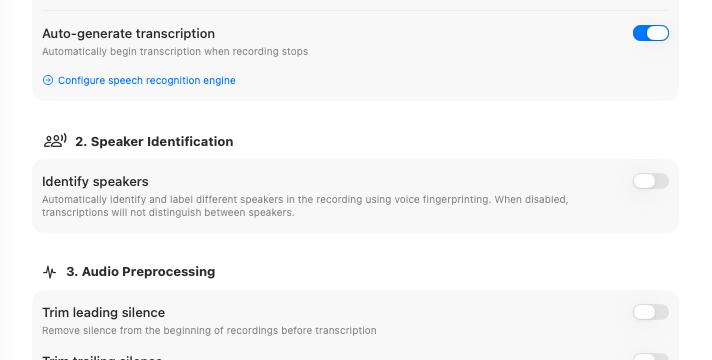
Turn it off — and Summit stops creating voice embeddings entirely. You get the transcript, the summary, the action items. No voiceprints. No biometric data. Nothing that touches BIPA, GDPR, or any other biometric privacy law.
For users who need full compliance — especially in healthcare, legal, or finance — this means zero biometric data risk. Not “we store it securely.” Not “we comply with regulations.” Just: we don’t collect it at all.
That’s the only compliance guarantee that actually holds.
Questions to Ask Your Current Tool
- Does it create voiceprints or speaker embeddings?
- Where are they stored?
- What consent was obtained from non-users?
- What’s the data retention policy?
- What happens if their servers are breached?
- Can you disable speaker identification entirely?
Bottom Line
Your voice isn’t just audio — it’s a biometric identifier that can’t be reset. Before sending it to the cloud, know what you’re consenting to.
And if you’re in a regulated industry — or just value your privacy — consider tools that let you turn off biometric collection entirely.
Try Summit — meeting notes that stay on your device. Download for macOS
References
- Fireflies.AI BIPA class action lawsuit (December 2025)
- Illinois BIPA Section 15(b) — consent requirements for biometric data
- Fortune: “The dark side of AI meeting notes” (February 2026)
- Lyon Firm: BIPA voiceprint litigation tracker (February 2026)